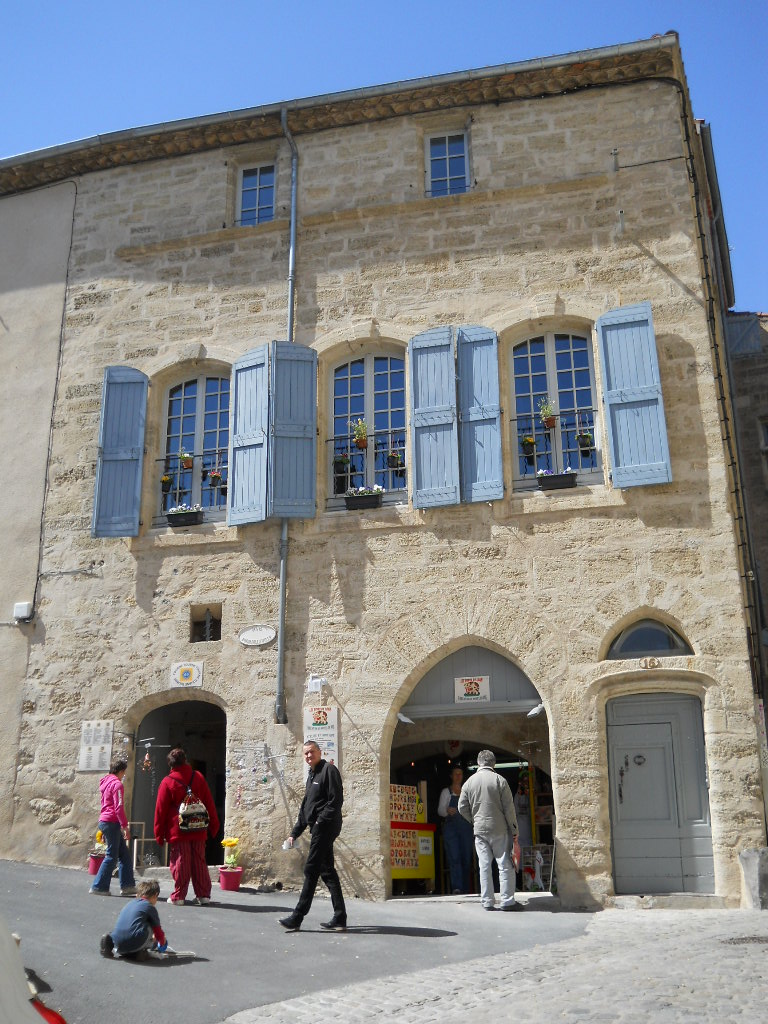
When comparing our lives here in the south of France to our lives in San Francisco & New York, it's no surprise that there are many major differences, but sometimes it's the little differences that we notice.
Maybe it's just the town where we live (Pézenas, in the Hérault, Languedoc-Rousillon), but it's very common to hear people whistling as they walk down the street. I can't remember the last time I heard anyone in the U.S. whistle. Maybe it's just easier to hear when there isn't constant noise from traffic, & I'm sure the sound bounces off the old stone buildings, but I don't think that's the reason. I think it's just that whistling is a forgotten art in the U.S. (& likely elsewhere as well). Hearing someone whistling a tune as they go about their daily activities brings a smile to my face.
French kids seem to have a different approach to playing -- they actually interact with one another, run, kick a soccer ball, laugh, etc. American kids seem glued to their TV/computer/video games/electronic devices or are reliant on organized activities & have lost the art of pure play. It's quite common to see very young (3 or 4 years old) children riding a 2-wheel bike without training wheels. I can't imagine an American parent even thinking of allowing that. In fact, I'm sure they don't even make 2-wheel bikes that small in the States. It's pretty rare to see anyone -- adult or child -- wearing a helmet while riding a bike, & there are definitely no laws requiring them.
Speaking of youngsters, most American parents wean their tykes off the pacifiers (dummy or soother to you Brits) at a fairly young age -- not here. Seeing a child of around 5 or 6 with a Nuk in his mouth would be considered strange in the US, but not in France. I wonder what it does to the way their front teeth come in.
......and then there's the dog poo. Sigh...... I cannot fathom why people who are otherwise clean, sometimes fastidious, allow their pooches to leave little "gifts" whenever & wherever they please. Hasn't anyone heard of picking up after their dog? The worst was when I was leaving the house one day, & just as I was about to put my foot down I noticed (just in time!) that some pooch had left a gift for us, smack-dab at the bottom of our front step. Ugh!! If you're not going to clean up, please do not allow Fifi or Fido to poop right in someone's doorway. People around here probably think I'm rude or highly introverted because when I walk I generally look down hoping to spot every pile of poop before my foot finds it. A friend sent me this image & it's so true!
Vive la différence?
What little differences have you noticed?
Someone, somewhere in France needs remedial training in the number of days in a month. From the perspective of a couple of non-natives, French prescription medications here are pre-packaged in quantities that don't always make sense. In the U.S. when the pharmacist fills the prescription, the prescribed quantity of pills (capsules, tablets, etc.) is counted out by hand or by machine & then put into the vial & labeled with dosing instructions. In France, with one exception, I've only seen pills that come pre-packed in small boxes with push-through inserts, such as the photo below (for a non-prescription medication). The exception was a medication that was pre-packaged in bottles, but this meant that to get the correct number of pills, I needed to buy two bottles, because one bottle did not have quite enough, & I was left with a nearly full bottle of pills after taking the prescribed dosage for the illness.

The packaging shown here is a waste for only 12 pills and it creates more for the landfills, but that is not really the issue. With prescription medications the quantities often don't make sense. For instance, when a doctor prescribes meds that are to be taken daily, the boxes contain either 28 or 30 pills. When looking at a calendar it quickly becomes obvious that there is only one month with 28 days, & only four with 30 days, which means that you will run short of pills in seven of the 12 months. The doctor writes the prescription for 3 months, so it generally necessitates quarterly trips to the doctor, which is reasonable. But, when the pills run out before the end of 3 months, this means that one has to go back to the doctor more frequently to get new prescriptions. Of course, one does not run out of all the pills at the same time, because each medication (& each brand of a particular medication) comes with a different number of pills.
In the grand scheme of things, it's not a huge issue, rather something a bit perplexing to someone not used to this system.
After a long -- 2 years -- hiatus, we're blogging again, this time with a focus on food. There are some foods in France that we assumed were the same as in the U.S., but that's not always the case.
For example, celery in France is not generally eaten raw; instead, it's used in soups & stews. Taking a bite of raw French celery, we were surprised to find out how tough & bitter it usually is. When cooked in soups & stews, the flavor & texture become milder, so it's fine in those cases, but if we want some crudités for a snack, celery is out. On the positive side, if we want to buy only 1 stalk, that's easily done.
Carrots were another surprise. The majority of carrots we find are rather fat & also have a bitter taste when eaten raw, but they are fine in soups & stews. At the market I search for the skinniest carrots I can find, which can take some digging. We occasionally see bags of miniature carrots (which are ubiquitous in the U.S., but unusual here) but have yet to buy them. Aside from their high cost, we worry that they will still have the same bitterness as the large carrots, but in a smaller format.
Most potatoes in the U.S. have a relatively high starch content; not so with most potatoes in France. They are either waxy (like new red potatoes) or watery when cooked. We made our favorite potato salad recipe but it wasn't quite right because it really needed the starchiness of Idaho potatoes. From time to time we find bintje potatoes at the weekly market or buy a bag of specialty potatoes at the grocery store, but mostly we don't eat baked potatoes or make American potato recipes. When we want convenience foods, there are several yummy frozen potato preparations -- duchesse, noisettes, mashed potatoes, etc.
Corn on the cob is something we really miss. While driving across certain parts of France we've seen huge fields of corn, bit it's rarely seen in the grocery stores, & I've never seen it at our weekly market. It turns out that the fields of corn were a different strain of the veggie, destined to become animal feed. On the occasions when we see corn on the cob at the store, it's imported (usually from Africa), of inconsistent quality, & expensive enough to be considered a treat. It's easy to find canned corn (Green Giant is definitely the best brand), so we know the French eat corn, but usually in salads. Actually, corn has only been considered edible within the past 40 years or so; before that, it was used almost exclusively as animal food.
We won't even write about French beef because it's been covered over & over again by many ex-pats.
Canned, condensed soups are not sold here. Soups are either in cartons or jars (not condensed), or are dry soup mixes. A common soup in the in the south of France is soupe de poissons (fish soup), & several variations can be found in any grocery. But -- no clam chowder, so we'll definitely make sure to eat some the next time we're in the States.
On the plus side, duck breast, rabbit & pheasant are easily found & not considered delicacies. Chicken here actually tastes like chicken used to taste in the U.S. because it's not overbred & force fed. We can buy different kinds of chicken -- yellow (corn-fed) chickens, chickens for stewing, for roasting, etc., as well as coquelets (about the size of a Cornish game hen). Eggs are so much better here -- they have taste & are fresh, unlike in the States where they sometimes sit in refrigerators for 6 months before they get to the supermarkets. Here, they are not even in the refrigerated section of the store. All eggs here have brown shells, not white.
It's quite common to see meats in small packages in the grocery store -- a single pork chop or chicken breast cutlet. Not everything is super-sized, which is great when there are only 2 of us.
Then there is the wine....We live in the Languedoc, the world's largest vineyard, so we are surrounded by wine. Walk or drive nearly anywhere around Pézenas & you will see vineyards. Wine is not considered a luxury here & wine snobbery is not as prevalent. Many local residents buy their wine "en vrac" (in bulk). Simply bring your plastic jug (5 or 10 liters) & have it filled at the tanks. Our local wine cooperative (here's a link to their Facebook page https://www.facebook.com/lescaves.moliere.1) sells 4 varieties of everyday bulk wines at great prices -- around 1.20€ per liter (white, dry rosé, merlot, red table wine). Their bottled wines are quite good as well. They are certainly not the only caveau in the area that sells wines this way; it's the norm around here.
Little by little we are getting used to the differences & are embracing them, but right now we are craving a dinner of American steak, corn on the cob & baked potato.
Life has been moving along here in Pézenas. Spring has finally arrived, & we are glad to be rid of the freezing winter weather. The trees are no longer bare, & the grapevines are now fully covered in beautiful green leaves, making the countryside beautiful. The shops here in town have re-opened for the season, & the town has come alive. Tourist season is kicking into high gear & there is much more life and energy in Pézenas.
Also, we have found our new home and are getting ready to move. This wasn't as easy as you might think. We had decided to rent rather than buy, giving us more flexibility if we want to move at some point in the future. The real estate market here is suffering from some of the same challenges as in the U.S. & we did not want to be stuck with a house we could not sell in the future. Renting seemed to be the best option for us. Well, it would be if we had income here in France. Our income is all from the U.S. In a nutshell, because of rental laws, it is very difficult to evict a tenant, and landlords carry certain insurance, which they cannot get if the tenant does not earn an income from a French employer. We spoke with several rental agencies; one told us it was impossible to rent, & another wanted us to put down an additional deposit equivalent to one year's rent. This was getting expensive & difficult. We also looked into renting directly from owners, but the few places we looked at were pretty awful.
Then, through a friend, we found a great apartment here in Pézenas. Our friend knows a couple from New Zealand who live in the building, & they had faced the same problem, but the owner decided to take a chance & rent to them. He opted to simply not take out the insurance -- such a simple solution, but one that puts a landlord at risk.
After looking at their apartment (theirs is 3 bedrooms/2 baths, ours is 2 bedrooms/1 bath, but with a similar layout), we decided to look into it. We spoke with the owner, sent him our financial information (proof of income, etc.) & he agreed to rent to us if we like the apartment. We then made an appointment with the agency to view the apartment & decided it suited our needs perfectly. After a few more phone calls & visits to the agency and the apartment, we signed the lease & will be moving sometime during the first week of June, as soon as our household goods arrive at the port & clear customs.
The building has a long history -- the first parts of the building were built in the 14th century, with later additions over the following century. It was fully renovated 2 years ago, with lots of attention to detail. It's bright & cheery & gets lots of sunlight. It's in the old part of Pézenas, full of charm, winding streest, & great shops. We look out onto a small plaza, see rooftops, the church steeple, & the hills beyond that. There is a glassblower's shop across the plaza, & he sometimes moves his work outside the shop, so we get a free show from the window. There is a great little café/bistro downstairs & around the side of the building, & a number of other cafés & restaurants just a few steps from our front door. It's the best neighborhood in Pézenas. The only downside is that we have to walk up 2 flights of stairs, but I like to think of it as getting daily exercise. In our current house, everything is spread over 3 floors, & some days we go up & down 20 times, so it's really not much different.


Because apartments in France rarely come fully equipped, we went shopping for a fridge & oven (there is an electric cooktop installed already). We also bought a TV & a DVD player. We need some lamps as well. Appliances here are much more expensive than in the States. One thing the apartment has that is unusual is closets. We have a big closet in each bedroom, & a fair amount of cupboards in the kitchen.
The Internet service package we started last November (which we'll be moving to the apartment) includes TV, but as our current house has satellite TV, we never activated it. Yesterday we picked up the converter box for the TV, & when the TV is delivered (along with the fridge), they will install it. Can't wait! I just hope we can move the main Internet equipment & phone ourselves without any problems.
We're busy notifying everyone about our new address, but also needed to notify La Poste, and request mail forwarding service. In France, it is not free. We paid 23€ (about $30) for 6 months of forwarding. The U.S. may be the only country that offers this service for free. On the other hand, we notified our French bank of the move, & we do not have to pay to get new checks printed.
Next on our agenda is telling the local police the date the movers will be here (for traffic control & permitting), & to find out if the same situation applies to delivery of the fridge, etc.
Well, that's it for now.
As you might imagine, life in a village in Languedoc is not the same as life in the San Francisco Bay Area. Here are just a few of the differences we've noticed so far, with more to come in future posts.
When we make errors in our French (an all-too-frequent occurrence), we are gently corrected in a way that does not embarrass us. For instance, when in a boulangerie to buy a loaf of bread, I asked for un baguette & the boulanger repeated our request correctly -- une baguette, as though she were confirming our order, rather than correcting us. The same thing happens when we mangle our pronunciation of a French word. We have yet to run into a situation when they snickered or pretended not to know what we were saying.
Speaking of stores, when entering a store one is always greeted -- "Bonjour monsieur" or "Bon soir madame", not only by the staff, but usually by the other patrons as well. When leaving, it's the same thing: "Bon soirée" or "Bon journée."
The polite greetings, however, do not always translate to what Americans would call customer service. For example, we went to the local Carrefour (large grocery on the edge of Pézenas) recently & wanted to purchase an item we saw in the sale flyer. We looked where we thought it would be & didn't find it so we went to the customer service counter to ask where we could find it. The young woman there looked at the ad, shrugged & then asked a colleague. The 2 of them pointed vaguely in the direction I had already looked, but I went there again, in case I missed it the first time. When I didn't see it there, I returned to the counter & was given yet another shrug but no further assistance. Keep in mind that the Carrefour is a rather large store & there are many items. The good news is that I eventually found it myself.
Driving here is different. One-way streets & signs indicating "no left turn" seem to be mere suggestions. Drivers will often tailgate, sometimes honking the horn, & will pass at the earliest opportunity, only to drive even more slowly than you were in the first place. If you are going to need to change lanes to exit it's a good idea to do so long before you have the need, as drivers here are not always generous in allowing you to move in front of them. They, of course, will cut in front of you without giving it a second thought. One evening, on our way back from a couple of days in Provence a driver tailgated dangerously & swerved around our car at the last second, nearly pushing us off the narrow country road. Defensive driving is the rule. On the positive side, when someone parks in the middle of the street, people don't seem to get upset -- they merely back up & find an alternate route.
The concept of forming an orderly line (queue if you are British) is hit or miss here. When boarding a bus it becomes a free-for-all, with everyone bunched up at the door, trying to be the first to board, and absolutely no consideration for the elderly or infirm waiting to board. Nobody pushes or shoves or argues & everyone gets on the bus. If boarding a bus or train that is already fairly full, people "of a certain age" or frequently offered seats, more often than in the US. At the grocery yesterday the line for one of the cashiers came from 2 separate directions simultaneously. We guess it all worked out, but we never saw the entire thing because when another cashier opened we made a mad dash & were out of the store shortly after that. We have to say, though, that everyone seems calm & takes it all in stride.
We're not sure whether prostitution is illegal here. There is one road we travel frequently that has many prostitutes standing or sitting along the side of the road, waiting for business. It is out in the open so we wonder what the law is here. In the States, one generally only sees prostitutes in really bad neighborhoods -- & only when the police feel like allowing it. Here, it seems like a part of everyday life & it's taken in stride. Attitudes toward sex & bodies are definitely different in France than in the US.
Speaking of bodies, it's not unusual to see a man urinating in a parking lot or against the side of a building. It's viewed as a natural act, & not something to hide. I'm a bit ambivalent about this.
Shopping malls: Just as in the US, at malls here you'll find "mall rats" -- teens hanging out. Of course, the malls have the usual mix of stores, cafés, cinemas, etc. One thing we've seen at malls here that we've not seen in the US is farm animals. A couple of months ago we were in a mall & heard strange sounds, so we walked down the hallway & around the corner to see what caused the noises. We were surprised to see 100 or so cages of large birds -- every sort of chicken/rooster imaginable, some of which were quite bizarre-looking, as well as some pheasant, geese, peacocks, etc. They were apparently for sale, but it had also become an attraction for local school groups. Too bad we didn't have our camera with us that day.
Then, yesterday, we were in a different mall & saw a crowd gathered around a small fenced-in area containing farm animals....sheep, goats, chickens, rabbits, a squealing pig, etc. It was a sort of a petting zoo, & the timing of the display was probably to coincide with the school holiday & the children were really enjoying it. To be honest, having always lived in major metropolitan areas in the US, we're not entirely sure these displays are uniquely French, or whether similar things can be found in small towns & rural areas in the US.
Holidays & fêtes: There seems to be an endless calendar of holidays & fêtes here, some religious, some national, some specific to a town or village, & the majority of them seem to have a specific food or pastry associated with them. There is a cake for Christmas (bûche de Nöel), a different one for Epiphany (galette du roi -- similar to New Orleans Mardi Gras king cake) with a favor/charm baked inside. The person who gets the piece of cake with the charm inside is declared king & wears a paper crown. One interesting trivia fact is that the galette served to the President of France does not contain a favor because since the revolution of 1870 the French constitution states that nobody living in the Elysée Palace will wear a crown. There is a different pastry for St. Blaise (the local patron saint), & crêpes are served for Candlemas. Beignets -- similar to donuts, but without the hole -- are the pastry eaten at Mardi Gras. Foie gras seems to be the favorite food for all celebratory occasions, & oysters (along with lots of other shellfish) are de rigeur for New Year's.